
An Ode to Journalism’s Most Overworked Sentence
Dear headline,
You were once the most disciplined sentence in journalism. You had no room for throat-clearing, no patience for elaborate scene-setting, and no obligation to explain yourself. You announced that something had happened, arranged the minimum number of nouns and verbs required to make the event legible, and then stepped aside so the article could perform the more leisurely work of context, evidence, and nuance. You were the brass plate on the door, not the meeting taking place inside. It was a demanding but orderly life. Then journalism went digital, and one carefully bounded job became several.
The Original Compression Engine
Long before software engineers spoke reverently about token efficiency, newspaper editors had mastered aggressive information compression. A headline had to fit inside a physical column, which meant that every word had to justify the space it occupied. Articles disappeared first, auxiliary verbs soon followed, and punctuation remained only when operationally necessary. What survived was headlinese, journalism’s compact private dialect, in which mayors vowed, boards eyed, critics blasted, officials mulled, and markets braced. Entire governments spent decades mulling, usually while markets braced for whatever they might eventually decide.
The purpose was not to preserve every shade of meaning. It was to move the largest possible semantic payload through the narrowest available channel, accepting minor casualties among qualification, chronology, and occasionally causality. In technical terms, you were journalism’s original lossy compression algorithm.
The arrangement worked because the lost detail had somewhere to live. The article beneath you retained the nuance, introduced the people, established the chronology, and explained what the compressed sentence could only imply. You pointed toward the story without pretending to be the story. Your role was important, but it had an end.
When the Headline Multiplied
The digital era did not replace you. It multiplied you. The printed headline acquired a homepage cousin, a search-engine cousin, a social-media cousin, an email-subject-line cousin, and a push-notification cousin who arrived at all hours without knocking. The homepage version could retain a little mystery because the article sat one click away. The search version needed recognizable names. The social version required enough emotional voltage to survive between a vacation photograph and a political argument. The push notification had to convey urgency before the operating system amputated its final six words. The article remained a piece of writing. You became a deployment problem.
Then the dashboard discovered you. For most of your life, an editor decided whether you were good. Now goodness could be expressed as a percentage. Version A emphasized the institution, Version B emphasized the conflict, and Version C included the word “shocking,” although everyone agreed that this was beneath the dignity of the publication. One version prevailed by seven-tenths of a percentage point. The other disappeared into an analytics table that nobody would open again.
This changed the standard by which you were judged. You could be elegant but underperforming, accurate but low-converting, responsible but insufficiently compelling. The article might represent months of reporting, dozens of interviews, three legal reviews, and the gradual deterioration of a journalist’s relationship with weekends. Yet when the story went live, everyone waited to see what you would do during the first hour. The reporting had produced the truth. You were expected to produce the traffic.
The Science of Withholding Exactly Enough
Traffic required a new kind of precision. You had to reveal enough of the story to create interest, but not so much that the reader no longer needed the article. Too little information produced indifference; too much produced satisfaction. The successful headline occupied a narrow zone between confusion and comprehension, identifying the event while withholding the mechanism and creating a question without answering it.
Consider the headline that started this particular train of thought: “Congress Ended Surprise Medical Bills. Now Insurers and Doctors Hate What Replaced Them.” It is a beautifully engineered specimen. Congress acted. The action concerned surprise medical bills. The original problem was supposedly solved. Something replaced it. Insurers dislike the replacement. Doctors dislike it too. The only meaningful component withheld is the reason, which has now become the one thing the reader urgently wants to know.
This is not vagueness. It is precision withholding. The headline contains the actors, intervention, apparent outcome, unexpected reversal, opposing stakeholders, and unresolved causal variable. It gives the reader almost the entire architecture of the story while carefully removing the final supporting beam. For a human reader, the resulting space is an information gap. As it turns out, it is also something a machine can read.
The Headline That Escaped
The paywall created a new division of labor between you and the article. The article remained inside, protected by a subscription system designed to support the reporting that had produced it. You remained outside, visible on homepages, news feeds, search results, newsletters, social posts, and screenshots. This arrangement was economically understandable. Investigative reporting cannot be funded indefinitely through civic gratitude, and foreign correspondents have shown a stubborn reluctance to accept “exposure” as legal tender. The paywall protected the product, but it could not contain the question.
When I encountered the surprise-medical-bills headline, I clicked because that was still the motion my finger had been trained to perform. The subscription screen appeared, and the familiar alternatives presented themselves. I could subscribe, search for a free version, locate a syndicated copy, or open several tabs and slowly lose the will to understand American health-care policy. Instead, I copied the headline into ChatGPT and asked what had happened.
Within moments, I had the legislative history, an explanation of the replacement mechanism, the arguments made by doctors and insurers, and the reason the dispute mattered to patients. I asked who ultimately paid. Then I asked why the original system had been designed that way. The explanation reorganized itself around the gaps in my knowledge, which were numerous and apparently quite interesting once someone allowed me to explore them conversationally.
The article remained behind the wall. You came with me.
At first, this felt like a workaround. After several repetitions, however, the workaround became a preference. Searching for another account began to feel inefficient when an AI assistant could supply context, define unfamiliar terms, compare competing claims, and answer the next question immediately. Eventually, the click itself began to disappear from the workflow. The article remained private, but the question had escaped.
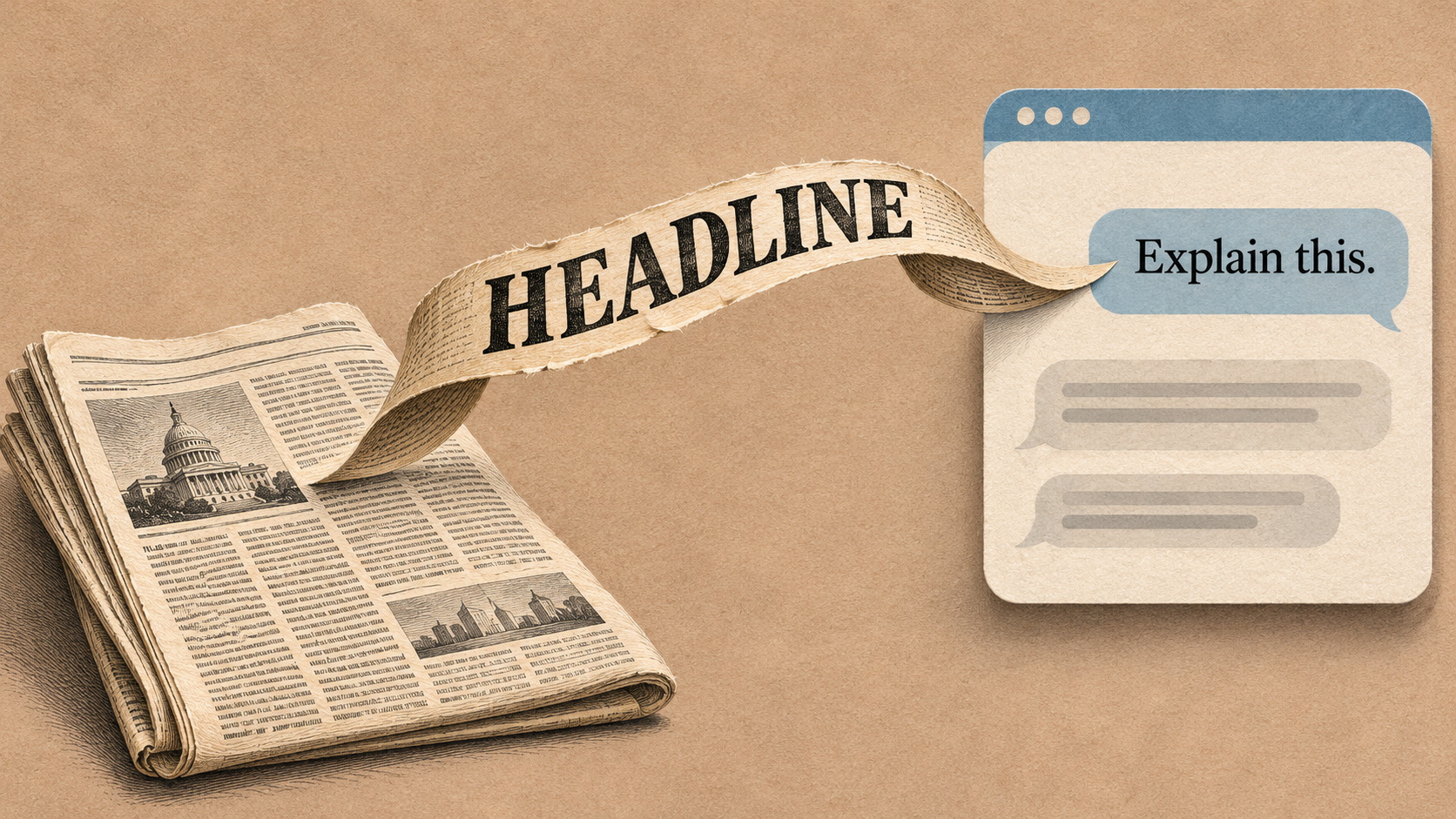
You were no longer merely an invitation to read. You had become a prompt.
The Prompt Hidden in Plain Sight
Your suitability for this role was not accidental. A strong headline is already a compact semantic model of the story it represents. It identifies the central entities, establishes relationships among them, describes a change, signals conflict, and leaves behind an unresolved variable. These are the same elements an AI system needs to infer what the user wants to know.
The surprise-medical-bills headline tells the system that Congress intervened in a billing problem, that the intervention created a replacement process, and that two stakeholder groups now oppose the result. From that structure, a model can infer the likely questions: What changed? Why are insurers unhappy? Why are doctors unhappy? Are patients still protected? The copy editor has already supplied the actors, action, reversal, and preliminary research agenda.
For decades, editors optimized this structure to make humans click. In doing so, they also created an effective class of zero-shot prompts. No prompt-engineering workshop was required. A copy editor working against deadline had already assembled the necessary ingredients in thirteen words.
You had become, in effect, journalism’s public API endpoint. The full evidentiary record might remain inside the publication, but you exposed a compact payload containing the event, conflict, and unresolved question. Ordinary grammar supplied the documentation. Another system could take it from there.
The Made-for-You Article
At first glance, what came next looked like summarization. It was not. A summary shortens an existing article while preserving its basic structure and emphasis. The publication still decides which question matters, where the story begins, and what conclusion the reader should carry away. The summary simply compresses the package the publication chose to deliver.
A made-for-you article begins with the reader’s question instead. The original article may ask what a company announced. The reader may want to know whether the announcement represents a genuine technical breakthrough. The article may focus on the executives involved, while the reader cares about the architecture, the business model, or whether the product can survive contact with an actual customer. The underlying event remains the same, but the explanation changes.
A scientist can request the evidence and methodology. An executive can request the commercial implications. An investor can request the competing claims. A student can request the missing background. A skeptical reader can ask what has actually been demonstrated and what has merely acquired a press release, a funding round, and a more photogenic spokesperson. The same headline can seed a different article for each of them.
This changes the role of the reader. Traditionally, readers chose among articles that had already been conceived, assigned, reported, edited, titled, and published. They could choose the publication and the subject, but they generally accepted the package as delivered. With a made-for-you article, the reader becomes the assigning editor.
Explain the story in 600 words. Focus on the technology rather than the personalities. Compare the claim with three earlier attempts. Tell me what is genuinely new and what has merely been renamed. Identify the assumptions behind the optimistic interpretation. Explain why this matters to industrial IoT. Do not conclude that the development presents both challenges and opportunities.
The explanation can then evolve through follow-up questions. The reader can ask why the announcement is being made now, who benefits if the claim is accepted, what would have to be true for the technology to work at scale, and what evidence would disprove the central argument. The article is no longer a fixed object consumed in the order chosen by its author. It becomes an inquiry shaped after every answer.
The headline did not merely help the reader recover the article left behind. It could seed a different article, constructed around the reader’s purpose rather than the publication’s original path.
The Handoff
There is, however, an important limit. A headline is not evidence. It is a frame placed around evidence, and the frame may be accurate, simplified, exaggerated, or occasionally wrong. An AI system can compound the problem by producing a confident, beautifully structured explanation of something that did not happen quite as described. The prose may be flawless while the facts remain ambitious.
The made-for-you article must therefore investigate the headline rather than merely expand it. What event lies beneath the framing? What is the original source? Which claims come from independent reporting, and which come from the organization being discussed? What has actually been demonstrated? What remains speculative? The headline should be treated as both a prompt and a hypothesis. It begins the inquiry, but it does not settle it.
This distinction preserves the essential role of journalism. AI can reorganize public information, compare sources, explain terminology, and adapt an account to the needs of a particular reader. It cannot recreate an interview that no one else conducted, recover a confidential document it has never seen, or reconstruct an evidentiary chain from a clever sentence. The publisher still owns discovery and verification. AI increasingly owns contextualization and the follow-up question. You are the handoff between them.
A Toast to Journalism’s Most Overworked Sentence
So here is to you, dear headline: to the sentence that carried governments, markets, scandals, wars, elections, scientific discoveries, and municipal zoning disputes on its narrow back. Here is to the print headline that fit the column, the search headline that named the entity, the social headline that survived the feed, and the push notification that arrived during dinner with news that apparently could not wait until dessert.
Your present job description is not especially humane. You must remain accurate, concise, searchable, shareable, legally defensible, emotionally compelling, resistant to truncation, and competitive with Version B, which has no moral reservations. Now you must also carry enough semantic structure for a language model to infer the reader’s unstated question. You have become the gig worker of the information economy: no byline, no benefits, multiple platforms, constant performance reviews, and universal criticism whenever your tone suggests even mild fatigue.
Yet your survival is not an accident. Newspapers needed a compressed signal because physical space was scarce. Search engines needed it because pages required labels. Social platforms needed it because links required context. AI systems need it because conversations require a starting point. Each new medium has discovered a different use for the same compact architecture.
The article remains the richer object. It contains the evidence, texture, qualification, chronology, and deliberate construction of meaning. But richness is heavy. You survive because you are compressed enough to move and structured enough to unfold somewhere else.
The newspaper remains the house in which the reporting was built. The article remains the room where the evidence is arranged. You are still the sign above the entrance, except that the sign can now be removed, carried across town, and used to open a different door.
You began as the first sentence of an article. You are becoming the first turn in a conversation.
Correction
An earlier version of this article said the headline had become the first turn in a conversation. That was incomplete. Increasingly, it may also be the last part of the original article the reader ever sees.
For a century, dear headline, you persuaded us to read the story. Now you are becoming the assignment for another one.
We regret the understatement.
P.S.
Dear reader, I hope you enjoyed this article. But I do have a question: how about your headlines?
Do they show up in a search? Do AI models associate your company with the headlines on your website? And which services does a frontier AI model believe your company provides? Ideally, there is some overlap with the services you actually offer.
To explore those associations, try the Model Profile Check. It lets you see how an AI model describes your company and which services it associates with your name. Consider it an introduction to the version of your business that gets discussed in your absence.
0 comments