
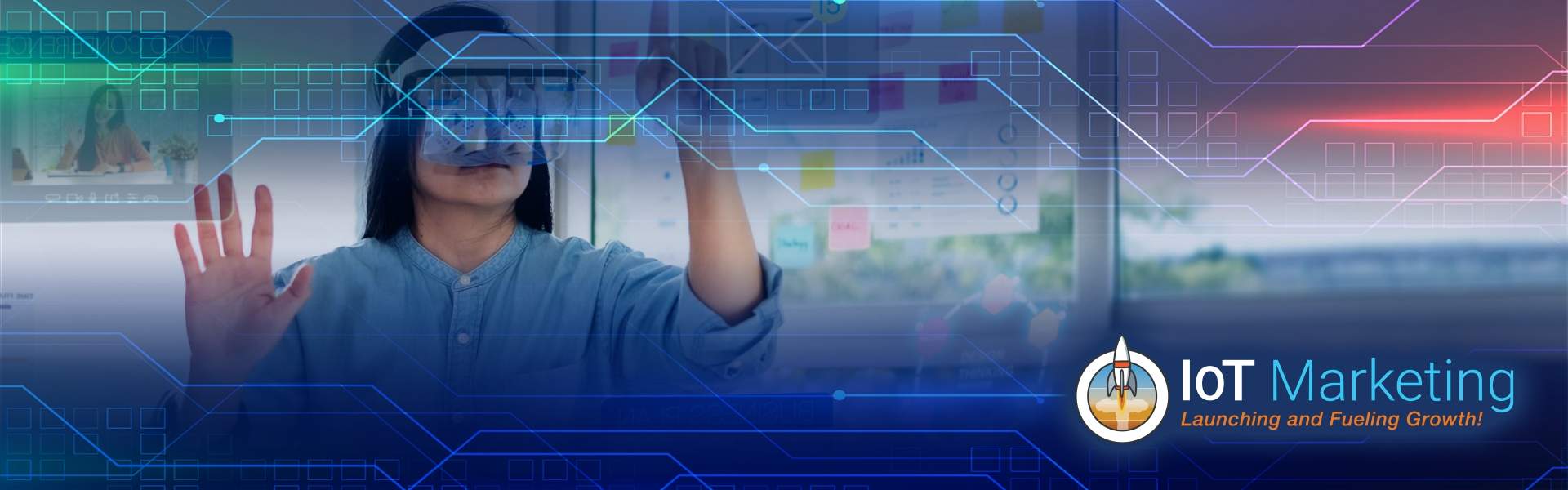
Various forms of interactive digital technology that mix the digital and physical worlds make up what is known as "immersive technology." It includes the internet of things (IoT), virtual reality (VR) and augmented reality (AR).
The combination of 5G, along with cloud and edge computing with IoT, contributes to this innovative space that expands computing capacities. Here's a look at how immersive technology and IoT can work together in a powerful way for your business.
Growing Demand for Immersive Technology
Businesses that are investing in immersive technology and IoT seek to provide diverse experience options in communication for staff, customers, partners and suppliers. The real estate industry has been at the forefront of this development, offering housing market participants a chance to experience a property for sale without visiting it physically. The use of VR headsets opens the door to panoramic and aerial views of a property that weren't possible in the past for home buyers.
Immersive technology not only has the potential to save money, but it can also expand awareness in a short time. It's excellent for training sessions because it can speed up the learning curve significantly in the manner it displays information for effortless consumption. Ultimately, VR and other immersive technologies enhance the workplace and customer experience.
5G, Cloud and Edge Computing
The advent of 5G wireless networks is helping to fuel the growth in immersive technologies by providing wider bandwidth and much faster connection speeds. Many businesses were able to continue operating during the pandemic by embracing remote work through cloud computing. The need for social distancing quickly created escalating demand for immersive technology.
With the explosion of big data transmission in recent years, businesses need to guard against clutter and network latency issues. It's not necessary to send tons of data from an IoT device to the cloud for computing if the data can be processed at its point of origin or "network edge." This concept, known as edge computing, allows for faster access to data.
Pioneers of Immersive Technology
Immersive technology, also known as XR, is being developed by some of the world's largest tech firms. Both Apple and Facebook owner Meta are releasing virtual reality headsets as part of the next generation of personal computing. It remains to be seen as to what degree headsets will become a consumer trend or norm since the price range will be from about $1500 to $2500.
Google was unsuccessful at marketing its Glass headset product to the medical industry last decade, partly because of its price and complexities. It was also prone to technical glitches and raised privacy concerns. But the company redesigned the headset with its more user-friendly enterprise edition introduced in 2017. This streamlined version has a touchpad and can respond to voice commands. Google has ventured deeper into immersive technology with its Google Earth VR software that allows you to travel the world on your computer without leaving your home.
XR streaming is a new solution in which a mobile device isn't required to use much of its computing power. Instead, computing power is provided by a local server or from the cloud. It essentially allows users to experience VR and AR content such as 3D CAD models. The data is only streamed instead of stored on mobile devices. Tech companies working on XR streaming via the cloud include Microsoft, Nvidia and Holo-Light. The idea of the scalable, pay-per-use model is attractive to businesses seeking affordable immersive solutions.
Multi-user Remote AR/VR Networking
So far, immersive technology has mainly catered to individual experiences, although interconnections are possible. It's just that AR/VR technology is still in its infancy, as interactions between individuals are slightly delayed with motion-to-photon latency. The next stage of development for immersive technology will be to facilitate practical multi-user remote AR and VR activities seamlessly. This milestone in new technology will simulate lifelike experiences, making remote group sessions even more like being in the same room. Only then will sci-fi visions of mixing physical and digital worlds start to become true.
The concept of multi-user remote AR/VR can be applied to many facets of business communication. One of the most visible areas of the market it has emerged has been online video gaming. Countless gaming sites have entered the market in recent years to get a piece of this rapidly-growing multi-billion-dollar market.
Some of the key industries that are already embracing AR/VR include retail, healthcare and tourism. Retail stores can capitalize on offering virtual experiences of products that aren't necessarily physically available in the store. Car dealerships have been very supportive of jumping into AR/VR as a way to showcase new car models without taking up massive showroom space.
Clearly, the tourism industry will benefit from AR/VR by letting people explore the world digitally before they do so physically. It will also help travelers find their way around new places. Adding IoT to these experiences collects data to help hotels and tourist attractions forecast travel revenue.
On the Immersive Horizon
Developers face the challenge of satisfying various technical requirements for seamless digital experiences. These requirements involve energy efficiency, latency, throughput and reliability. A major hurdle will be to overcome delay, jitter and data loss, which can all be perceived in multiple ways.
You will need a deterministic core network (DetNet) as the foundation to achieve the more realistic sensation of blending physical and digital worlds. This jitter-free form of packet transfer facilitates the global scheduling of packets through router buffers. Architecture for low-latency routing in the future will be based on these three pillars:
- Integrated network coding that minimizes latency: Distributed network coding is needed for multi-user AR/VR to ensure optimum throughput and minimal latency. Network coding can be generated by all nodes on the network. In this system, redundant coding is used only where needed.
- AI software for application-network collaboration: In an interactive communications system that includes machine learning software, the application can continuously monitor signal path quality through multiple channels. The AI element automatically selects the path with the best audio and video quality.
- Network slicing: This multiplexing architecture for virtualized networking allows independent networks to exist on the same physical infrastructure. It's useful for automatic configuration based on the demands of application providers. It runs overlay networks over radio, transport and core domains.
The key will be using a DetNet that supports Quality of Service (QoS), such as a heterogeneous 5G URLLC network. URLLC stands for Ultra-Reliable Low Latency Communications, which facilitates the shortest out of multiple paths for the most efficient data delivery. This type of network reduces end-to-end latency to just a few milliseconds. The future of URLLC networks will include improved waveform designs, coding schemes and control signaling.
Conclusion
Venturing into immersive technology and IoT can lift your business into a more seamless digital realm that intrigues your customers. The adoption of this combination will empower your business to explore VR/AR solutions that open up greater opportunities for capturing online revenue.
