
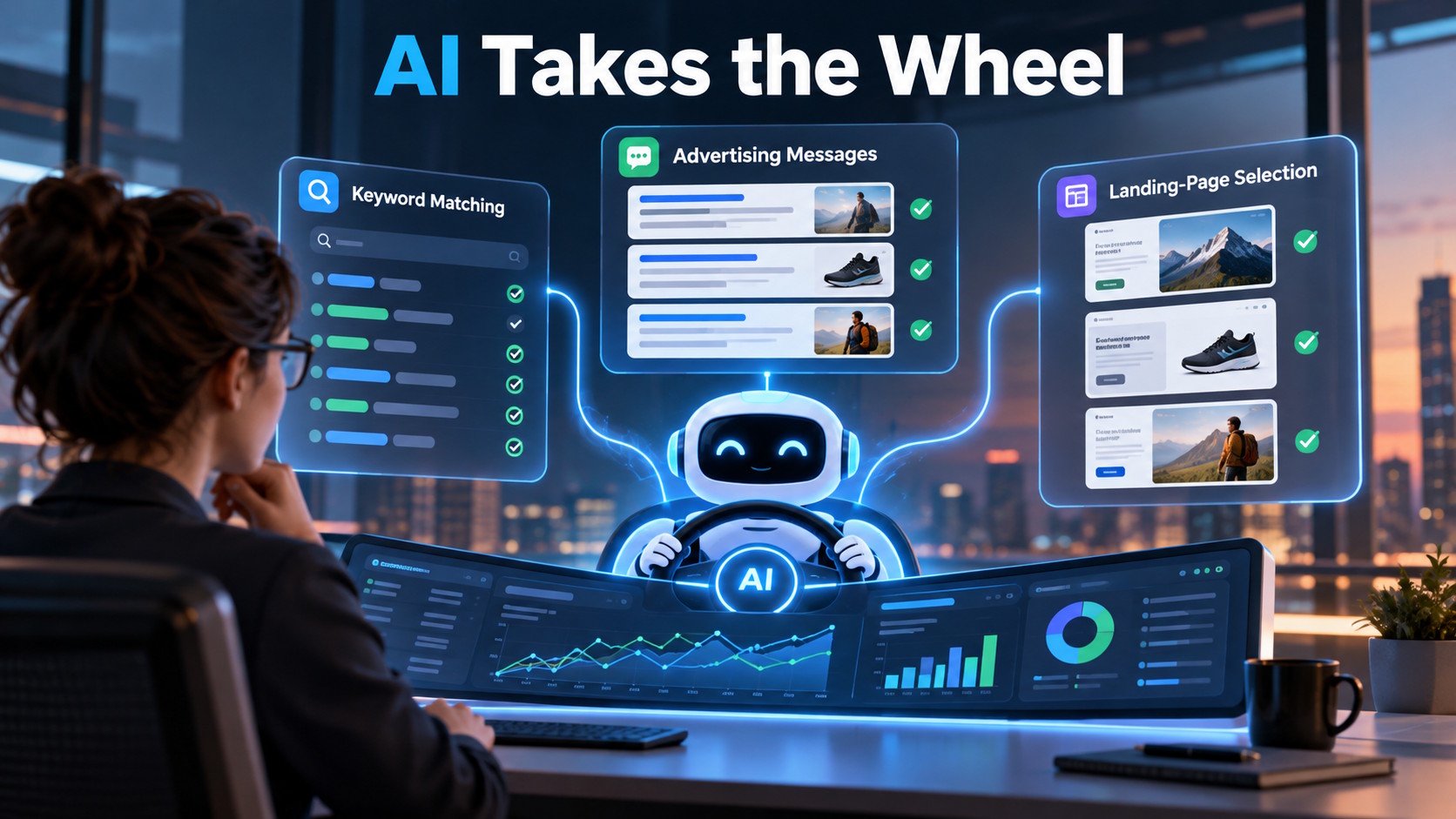
Quick Answer: Google is changing PPC ads through AI Max for Search, which expands how artificial intelligence manages search advertising. AI Max can identify relevant searches beyond traditional keyword matching, generate advertising messages, and select landing pages based on user intent. While these capabilities can improve relevance and reduce manual work, advertisers still need to monitor campaign performance, maintain accurate messaging, and ensure their ads reach the right audience.
Who’s Making the Decisions Behind Your Ads?
PPC ads are gaining more AI automation through Google’s AI Max for Search. For businesses investing in pay-per-click advertising, that raises practical questions about relevance, spending, and control. Within paid search, AI Max can expand search matching, generate ad text, and select landing pages.
You might welcome help finding customers, but you probably don’t want surprises in an ad carrying your company’s name. What happens when Google starts making more of those decisions? Understanding the changes can help you judge where automation fits—and where your team still needs to pay attention.
What Is AI Max for Search, Exactly?
AI Max for Search is a collection of AI-powered features within Google Ads Search campaigns. It is not a separate advertising service or a new campaign type. Instead, it adds targeting and creative capabilities to Search campaigns, with settings that advertisers can manage.
Google already offered automation before AI Max. Dynamic Search Ads, for example, used website content to match searches, generate headlines, and select landing pages. AI Max builds on that history rather than introducing automated search advertising from scratch.
The change, then, is not a sudden move from entirely manual advertising to AI. It is an expansion of the decisions Google can handle within your campaign.
Three Decisions Behind Your PPC Ads
The easiest way to understand AI Max is to follow one potential customer from search to website. Consider a hypothetical company that sells industrial equipment-monitoring software.
How do PPC ads reach beyond your keywords?
AI Max’s search term matching combines broad-match and keywordless technology to find searches beyond your existing keyword coverage. It draws on your keywords, advertisements, and website pages to identify additional opportunities. Keywords remain useful inputs, but they are not the only information Google considers.
Our example company might target “industrial IoT monitoring.” A factory manager, however, might ask, “How can I reduce unexpected equipment downtime?” AI Max could connect that search with the company’s offering, depending on campaign settings and available information.
This illustrates search intent: what someone hopes to accomplish, rather than just the words they enter. The potential customer describes a problem, while the company describes a solution.
What could your advertisement say?
Text customization can generate additional headlines and descriptions for PPC ads. Google draws on existing advertisements, website content, and generative AI to produce these additions. They can appear alongside advertiser-written text, rather than simply replacing every message your team creates.
In our example, the ad might emphasize equipment monitoring in response to a downtime-related search. That could make the message more useful without requiring someone to write every possible variation.
However, a relevant message must still make an accurate promise. “Monitor equipment performance” and “eliminate every breakdown” suggest very different capabilities. The wording deserves human attention, especially when a small change could overstate what your product does.
Where will the click take your customer?
A landing page is the webpage someone reaches after clicking an advertisement. With Final URL expansion enabled, Google can choose another relevant page on your website instead of the originally specified destination. This feature requires text customization, so those settings do not operate entirely independently.
For our software company, that might mean an equipment-monitoring page rather than a general homepage. The visitor could reach the relevant offering without searching the site for it.
That convenience depends on the page itself. Does it explain the product clearly, reflect current capabilities, and offer a sensible next step? A page can match the subject without helping someone decide whether your business meets their needs.
More Reach Sounds Good—but Is It the Right Reach?
You might now be asking, “Will AI Max make my PPC ads perform better?” A wider audience can create opportunities, but additional clicks alone do not demonstrate business value.
Returning to our hypothetical company, a downtime-related search might come from a buyer comparing monitoring software. It might also come from a student researching maintenance practices or someone seeking an equipment repair service. All three share a topic, but only one may fit the campaign’s intended audience.
The same distinction applies to inquiries. A completed contact form has limited value when the person needs something your business does not provide. For this example, useful evaluation would consider relevant conversations and sales opportunities, not just traffic.
The ability to automate these decisions is not, by itself, evidence that a particular business will gain better customers.
More Automation Still Needs Your Judgment
Do advertisers still have control? Yes, Google provides feature settings, brand controls, and options to exclude unwanted landing pages. Advertisers can also disable search term matching for individual ad groups. Google’s text guidelines let advertisers restrict particular words and unwanted messaging in generated copy. Google labels this feature experimental, so guidelines should complement review rather than replace it.
Your website also becomes part of the advertising process, not merely the destination after a click. Google recommends accurate, current website content and monitoring generated advertising text for accuracy. Reporting provides another way to supervise the results. Google includes reporting that connects search terms, headlines, and landing pages, helping advertisers examine how those elements work together.
For your team, managing PPC ads still means deciding which customers you hope to reach. Good oversight also means comparing the cost of those inquiries with their value to the business.
Conclusion: More Automation, the Same Business Goal
Google is changing PPC ads by giving AI more responsibility for matching searches, creating messages, and choosing website destinations. AI Max brings those capabilities into Search campaigns, with behavior that depends on the features and settings in place.
For a business considering AI Max, the useful question is not whether Google can automate another task. It is whether that automation helps suitable customers understand the offering and take a meaningful next step.
Contact us at IoT Marketing to learn how AI-powered search advertising could affect your PPC ads.
Sources:
Google’s Dynamic Search Ads Are Upgrading to AI Max | blog.google
About Text Customization in Search Campaigns | support.google.com
Use Text Guidelines With Performance Max and Search Campaigns (Beta) | support.google.com
Reports for AI Max for Search Campaigns | developers.google.com