Agentic AIoT
Artificial Intelligence

From Smart Devices to Smart Worlds: Agentic AIoT is Reshaping Everyday Life

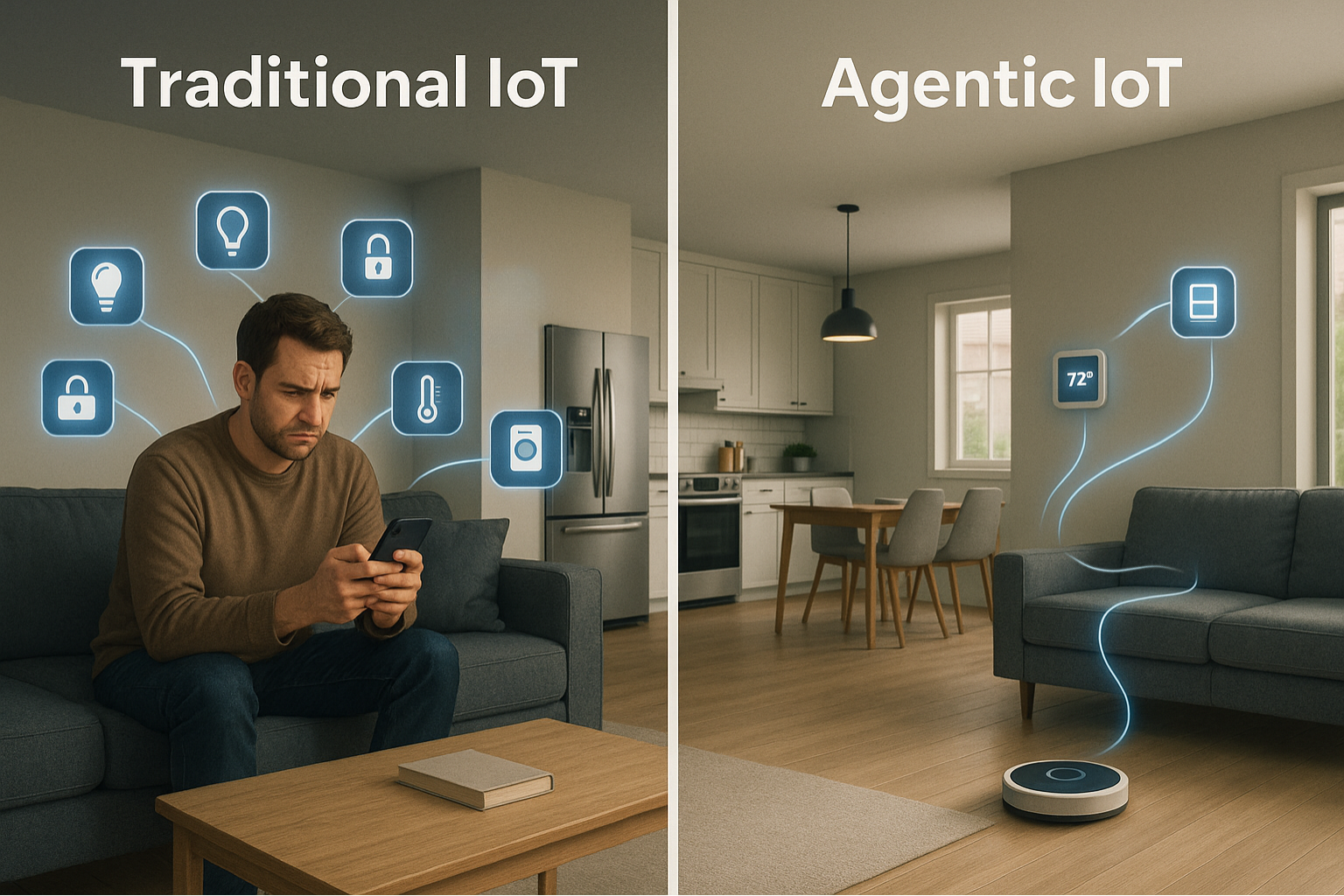
Imagine your smart devices doing exactly what you need without constant guidance. That’s the essence of agentic AIoT, an advanced form of intelligent IoT technology that empowers gadgets to make decisions autonomously. While traditional IoT connects your devices, agentic AIoT elevates them by infusing true intelligence and independent decision-making capabilities.

Why should this matter to you? Because managing a growing number of connected devices can quickly become frustrating and overwhelming. Agentic AIoT offers relief by simplifying interactions, streamlining daily tasks, and reducing the burden of constant management.


From Connected to Intelligent: What's Changing with Agentic AIoT?

We've all experienced the frustrations of "smart" technology that's not very smart. Have you found yourself repeatedly adjusting settings on a thermostat that promises to learn but doesn't quite get there? Traditional IoT devices need constant user input, leading to inefficiencies.

Agentic AIoT changes this dynamic entirely. With built-in intelligence, these devices can analyze situations and act autonomously. Imagine your home automatically adjusting lighting and temperature based on your behavior without constant prompting. That’s the promise of agentic AIoT.


Everyday Frustrations You Didn't Realize Were Solvable

Think about common frustrations like manually updating software on multiple devices or dealing with incompatible smart-home gadgets. Ever wondered, "Why can't these devices just figure it out themselves?" You're not alone.

With agentic AIoT, devices can identify issues and communicate seamlessly with each other, automatically resolving conflicts or updating software. Gone are the days of troubleshooting one device at a time. For example, when you add a new device to your smart home network, intelligent IoT systems automatically integrate and configure it, ensuring it communicates effectively with existing gadgets without manual setup.

Another common issue is energy management. Most of us struggle to reduce energy consumption effectively. Agentic AIoT provides intelligent solutions by learning usage patterns and adapting accordingly. It can proactively turn off devices not in use, identify energy leaks or inefficient appliances, and suggest actionable steps to optimize your consumption, saving both money and resources.

Security monitoring also becomes simpler. Traditional security systems often inundate users with false alarms or irrelevant alerts. Intelligent IoT devices can differentiate genuine threats from harmless anomalies by learning patterns and behaviors. This means fewer false alerts and more timely responses to actual incidents, providing peace of mind without the headache.


How Agentic AIoT Makes Life Easier (Without the Tech Headache)

Agentic AIoT doesn’t just promise to ease frustration; it actively reduces complexity. Devices powered by intelligent IoT autonomously learn from your habits and surroundings, making proactive adjustments.

For example, your smart refrigerator could monitor its contents, alerting you when items are running low or even automatically ordering groceries. Your vehicle could anticipate traffic patterns and adjust routes before you even start your journey. These are no longer futuristic dreams—they’re achievable realities.


What About Security and Privacy?

Naturally, the idea of devices making autonomous decisions raises security and privacy concerns. After all, who hasn’t worried about smart devices spying or leaking personal data?

Agentic AIoT, however, integrates advanced security measures directly into its autonomous decision-making processes. These systems don't just automate tasks—they intelligently respond to security threats, reducing risk. While there's a lot more to unpack here, rest assured that smarter devices also mean safer devices.


A Quick Look Ahead: Your Life with Agentic AIoT

Picture a morning where your home wakes up before you do, adjusting temperature, brewing coffee, and briefing you on your schedule, all autonomously. Imagine a commute streamlined by vehicles communicating in real-time, reducing traffic and stress. Cities powered by agentic AIoT could enhance efficiency, sustainability, and livability, responding dynamically to human needs.

This vision is compelling precisely because it's attainable. Agentic AIoT moves us beyond simply connecting devices to actively improving our quality of life.


Conclusion

Agentic AIoT represents an exciting leap forward, promising not just convenience, but a fundamentally smarter way to interact with our environment. Yet, we've barely scratched the surface. To truly grasp the transformative potential of agentic AIoT and how it's reshaping our physical world, you'll want to hear from industry-leading experts.

Join us for our virtual event, Intelligent Thinking AI Summit 2025, featuring the keynote "Agentic AIoT: Injecting Intelligence into Our Physical World." You won't want to miss the insights and actionable strategies our speakers will share.


POST EVENT CONCLUSION:

Agentic AIoT represents an exciting leap forward, promising not just convenience, but a fundamentally smarter way to interact with our environment. Yet, we've barely scratched the surface. To truly grasp the transformative potential of agentic AIoT and how it's reshaping our physical world, you'll want to hear from industry-leading experts.

Watch the keynote "Agentic AIoT: Injecting Intelligence into Our Physical World" from the Intelligent Thinking AI Summit 2025. You won’t want to miss the insights and actionable strategies our speakers shared—stream the replay now.

For additional articles on AI, IoT, and emerging technology, visit the Tech Scope Connect Content Hub.

Read More
an ai robot using a telephone
Artificial Intelligence

From Innovators to Mass Adoption: Understanding AI Agents and Their Impact

As begin the year 2025, many experts predict we’ll see the first wave of AI agents coming to market—heralding a new era in artificial intelligence. This initial deployment will be driven by innovators, including researchers, tech enthusiasts, and pioneering companies, who are eager to test and refine the technology. Although the larger public may not immediately feel the effects, these early experiments will shape how AI agents evolve, eventually guiding their journey from niche applications to widespread adoption.

In this post, we will explore what AI agents are, what they can do, and how the diffusion of innovation model helps explain their adoption curve—from the earliest innovators to the late majority. Along the way, we’ll look at the potential impact AI agents may have on industries and society as a whole.


What Are AI Agents?

In essence, AI agents are systems designed to perceive their environments, process information, and take actions to achieve specific objectives. Unlike traditional software that merely follows predefined instructions, AI agents often incorporate machine learning algorithms, enabling them to adapt to new inputs or changing conditions. Depending on their complexity, they can either execute simple, rules-based tasks or make more autonomous decisions involving sophisticated predictive and analytical capabilities.


Key Characteristics

  1. Autonomy: Operate with varying degrees of independence, reducing the need for continuous human oversight.
  2. Adaptability: Employ learning mechanisms (e.g., machine learning, deep learning) to refine actions over time.
  3. Goal Orientation: Take actions aligned with a defined set of objectives (e.g., optimizing a route, responding to customer queries, or generating insights from data).


What Can AI Agents Do?

AI agents have a wide range of potential functions, shaped by their level of sophistication and the industries in which they operate. Below are a few representative uses:

1. Automation of Routine Tasks

  • Simple chatbots for customer inquiries.
  • Email filters sorting messages by priority or category.
  • Scheduling assistants coordinating calendars and appointments.

2. Advanced Decision Support

  • Predictive analytics engines forecasting market trends or consumer behavior.
  • AI-driven financial tools detecting fraud or automating algorithmic trading.
  • Healthcare diagnostics systems analyzing patient data for more accurate diagnoses.

3. Creative Collaboration

  • Tools aiding in content creation, such as automated copywriting or image generation.
  • Agents offering design suggestions or product prototypes tailored to customer preferences.

4. Autonomous Systems

  • Self-driving vehicles leveraging real-time data to make complex navigation decisions.
  • Robotics in manufacturing environments capable of adapting to production changes on the fly.


The Diffusion of Innovation Model

AI agents are likely to follow the diffusion of innovation model, moving through identifiable stages as they become more refined and widely recognized for their value:

1. Innovators

  • Motivated by experimentation, they test and push early AI models to their limits.
  • Their efforts reveal both strengths and shortcomings, laying a foundation for further development.

2. Early Adopters

  • Visionaries and risk-takers who see competitive or strategic advantages in using AI agents.
  • Their use cases and results encourage others to explore AI agent solutions.

3. Early Majority

  • Pragmatic users who wait for proof of reliability and clear return on investment.
  • AI agents reach a tipping point here, becoming more commonly accepted and integrated.

4. Late Majority

  • Skeptical or cost-conscious adopters who follow once technology is well-established.
  • Benefit from mature standards, reduced costs, and widespread infrastructure.

5. Laggards

  • Resist change unless prompted by necessity or lack of alternatives.


Expected Adoption and Impact

  • Foundational (Innovator) Stage
  • Adoption: Likely limited to specialized research labs, tech startups, and industry pioneers in 2025.
  • Impact: Experimental but crucial for establishing real-world viability and identifying best practices.
  • Growth (Early Adopters to Early Majority)
  • Adoption: Larger enterprises and a broader market segment begin to see tangible benefits and adopt AI agents.
  • Impact: Efficiency gains, cost savings, and new business models start to shape industry norms.
  • Mainstream (Late Majority to Laggards)
  • Adoption: AI agents become the norm even for conservative sectors, culminating in ubiquitous integration.
  • Impact: Reshapes workflows, ecosystems, and customer expectations, turning AI agents into a standard feature rather than an experimental add-on.


Potential Challenges

  • Ethical and Regulatory Concerns: Privacy, accountability, and bias issues grow more prominent as AI agents handle critical decisions.
  • Skill Gaps: Implementing and managing AI agents require new expertise that may be scarce initially.
  • Costs and Infrastructure: Although cloud-based tools lower some barriers, advanced AI agents may demand significant computing resources and specialized data infrastructure.


Conclusion

With 2025 poised to be the year of AI agents’ arrival, innovators will lead the charge in testing and refining this new technology. If these systems follow the diffusion of innovation model, we can anticipate a gradual progression from niche usage among tech pioneers to routine deployment across industries. While the journey involves challenges—ethical considerations, skill development, and cost barriers—there is little doubt that AI agents will leave a lasting mark on both businesses and society as they become more capable and widespread.

Are you prepared to explore the possibilities of AI agents in your field? The future is just beginning—contact us to learn more about how these transformative technologies can impact your industry.

For additional articles on AI, IoT, and emerging technology, visit the Tech Scope Connect Content Hub.

Read More
nvidia ceo jensen huang image
Technology

NVIDIA CES 2025 Keynote: Pioneering the Future of AI and Computing

The NVIDIA CES 2025 Keynote has set the stage for groundbreaking advancements in artificial intelligence (AI), robotics, and computing. Led by CEO Jensen Huang, the keynote highlighted innovations that promise to reshape industries and redefine what’s possible in technology. From next-generation GPUs to AI-powered solutions, NVIDIA’s announcements are pivotal for businesses and tech enthusiasts alike.


Transformative Technology: Highlights from the NVIDIA CES 2025 Keynote


The GeForce RTX 50-Series: Redefining Graphics Performance

NVIDIA unveiled the GeForce RTX 50-series GPUs, featuring the cutting-edge Blackwell architecture. These GPUs, including the flagship RTX 5090, boast GDDR7 memory and PCIe Gen 5 support. The RTX 5090 doubles the performance of its predecessor, making it a game-changer for gaming and creative industries. Such advancements ensure NVIDIA maintains its dominance in high-performance graphics solutions.


DLSS 4: Pushing AI-Driven Graphics to New Heights

One of the keynote’s standout announcements was the introduction of DLSS 4. This AI-powered technology utilizes multi-frame generation to increase frame rates significantly. Gamers and developers can now experience up to 800% performance boosts without sacrificing quality or adding latency. This innovation redefines the limits of real-time rendering.


Beyond GPUs: NVIDIA’s Vision for Autonomous Systems

Cosmos: The Future of AI-Powered Machines

NVIDIA introduced Cosmos, a comprehensive platform designed to accelerate the development of autonomous robots and vehicles. By providing synthetic data and world foundation models, Cosmos enables businesses to build smarter, more capable machines. Early adopters, including automotive leaders like Toyota, are already leveraging this technology to enhance autonomous vehicle capabilities.


Project Digits: AI Supercomputing for Everyone

With Project Digits, NVIDIA democratizes AI supercomputing. This high-end desktop solution, powered by the GB10 Grace Blackwell Superchip, allows researchers and students to run large language models with up to 200 billion parameters. At a price point of $3,000, it bridges the gap between data center computing and personal use, empowering innovators across fields.


Conclusion: NVIDIA’s Impact on the Future of Technology

The NVIDIA CES 2025 Keynote showcased the company’s unwavering commitment to innovation. From the RTX 50-series GPUs to the Cosmos platform, these advancements promise to revolutionize industries, making AI and computing more accessible and powerful than ever before. As we look to the future, NVIDIA’s developments will undoubtedly drive progress across gaming, robotics, and AI applications.

For more details about the keynote and how to watch, visit TechCrunch’s coverage here.

Contact us if you want to learn more about NVIDIA’s innovations, AI, computing, and more.

For more technology articles like this, visit our Content Hub at Tech Scope Connect.

Read More
autonomous systems
Automation

Autonomous Systems Heading for Outer Space

Today’s aerospace industry is working on autonomous systems to launch in space. Current satellite constellations in Low-Earth Orbit (LEO) are paving the way for future robotic experimentation in space. Here’s a look at how autonomous systems are evolving for aerospace applications


Ushering in the Space Age of AI

When the International Space Station (ISS) was launched in 1998, it marked a new partnership among the United States, Russia, Japan, Europe, and Canada. It signaled a beginning of international collaboration in space. The station features autonomous systems and functions as a research lab for the global science community. The ISS completes its orbit around Earth every 93 minutes, which amounts to 15 orbits per day.

This century, several thousand satellites have joined the ISS in space, occupying various altitude levels in low-earth orbit. The ISS houses long-term space travelers who work with autonomous machines that gather and transmit data. It also utilizes forms of AI such as machine learning (ML) software, which can provide analysis of data captured in space. Robotic equipment manages the spacecraft and its inhabitants, providing tools to measure and enhance diagnostic and prognostic performance.


Autonomous vs. Automation

Within the context of space, it is important to note the difference between autonomy and automation. An automated system does not make choices for itself. It simply follows a highly advanced script where all possible courses of action have already been made. When an automated system is met with an unplanned situation that does not have a previously identified solution, it stops and waits for human intervention

When it comes to an autonomous system, it can respond to and rectify issues without human intervention. This problem-solving functionality is crucial because the communications latency between spacecraft and earth-based mission control centers can be as long as 40 minutes. Fundamentally, the ability to run thousands of solution scenarios in a short time frame can mean the difference between mission success or failure


Machine Learning in Space

One of the most important forms of AI used in space is fault management. ML software is constantly scanning systems looking to predict and detect vulnerabilities that trigger automated response. Fault management is a process that involves verification and validation. ML is a subset of AI and is distinguished in the sense that ML teaches itself through scanning a constantly growing database.

As big data is fed into an algorithm, ML programs process information similar to how humans do. People typically make decisions based on choosing the best solution from a set of options. ML-based robots are able to make decisions based on historical data and probability factors. The machine will make decisions based on how the options are prioritized by the programmer. ML can also be used to send alerts to analysts when new risks arise.

Advanced ML encompasses specialities such as deep learning (DL), in which the machine teaches itself to perform complex tasks such as image recognition. By feeding the system various photos of an object from different perspectives, the machine builds an image “in its mind” capable of memorizing and recognizing visuals. These capabilities have yet to be fully utilized for space applications


Groundwork for Future Space Applications

NASA scientists are currently exploring AI for space applications particularly to improve satellite operations. The fact that satellites only have a lifespan of about 15 years means they need to be monitored to determine when end-of-life conditions appear. Robots are more capable than astronauts of gathering and analyzing thousands of data points in mere seconds.

ML can further play a deep and powerful role in gathering Earth observation data from a spacecraft perspective. More knowledge is likely to be learned from robots than humans that travel in space. Mars rovers, for example, are already smart enough to teach themselves how to navigate on another planet, whereas that achievement might be difficult for a human without the help of robots. The concepts of space travel and space communications have been around a while, but the technology has finally come of age to generate actionable data about space that’s useful to humans. AI still has limitations, though, as it will still take decades for robots to take over the aerospace industry. In the meantime, researchers will continue to work on technology solutions that address gaps in the availability of human input during spacecraft operations. Altogether, the rise of autonomous systems in outer space will help increase equipment longevity for deep space exploration out into the farthest corners of the universe.


Read More