
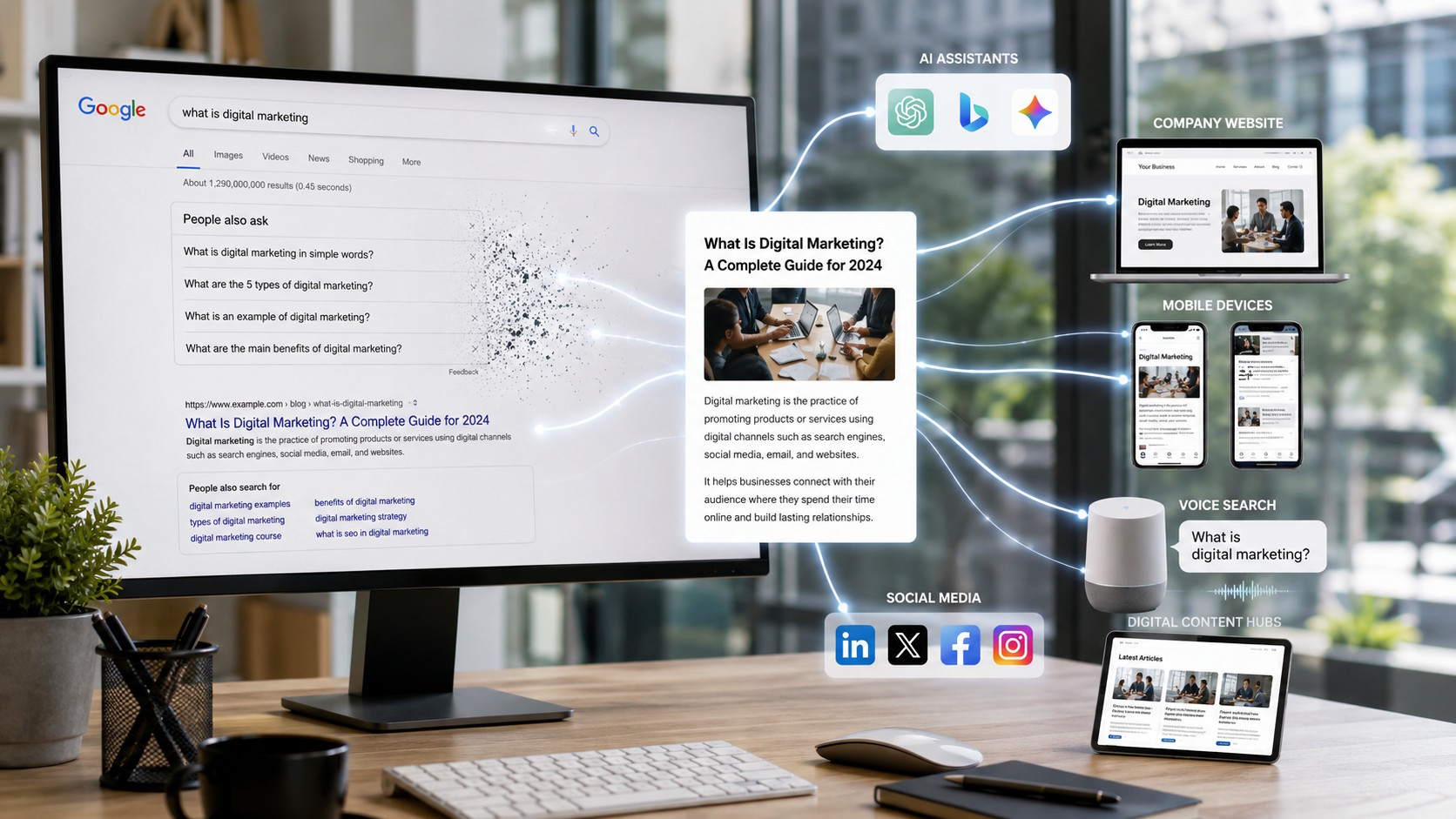
Key Takeaway: Google's removal of FAQ rich results does not mean FAQ content has lost its value. Instead, it reminds marketers to build content marketing strategies around answering real customer questions rather than chasing individual search features. Helpful, well-organized content can continue to support search visibility, user experience, and AI-powered discovery, even as Google's search results evolve.
A Search Feature Disappears, but the Questions Remain
Content marketing has never been static, and Google’s removal of FAQ rich results makes that especially clear. For years, marketers paired useful questions with hopes of earning more space in search results. The visual feature has disappeared, but the underlying content strategy still has important work to do.
Google stopped showing FAQ rich results on May 7, 2026, then removed its supporting documentation in June. The change closed the door on a familiar search enhancement. However, it did not erase the questions that prospects bring to Google, websites, social platforms, and AI tools.
The useful question now is not, “How do we replace that exact search feature?” A better question is, “How should we help people find clear answers wherever they look?”
The Search Result Changed, Not the Reader’s Need
FAQ rich results displayed selected questions and answers beneath a standard Google listing. They gave some pages a larger, more noticeable presence before a user clicked.
Google had already restricted the feature in 2023, largely reserving it for authoritative government and health websites. In 2026, Google ended the feature entirely. The company’s documentation now states that FAQ rich results no longer appear in Google Search.
For content marketing teams, the change can feel like a lost opportunity. A carefully written FAQ section no longer earns that particular visual treatment. Yet the reader who asks, “Does this solution work with our existing systems?” still expects a useful answer.
The same applies to questions about pricing, implementation, security, compatibility, and expected results. Those questions exist before a sales conversation begins. A website can either address them clearly or leave visitors to search elsewhere.
Why One Search Feature Should Never Carry the Strategy
Search features create incentives. When a new display appears, marketers naturally look for ways to qualify for it. That response is reasonable, but it becomes risky when the feature starts driving the content itself.
A page built mainly to win extra search space may lose its purpose when Google changes the interface. A page built to resolve a genuine customer concern keeps its value. It can support a sales conversation, improve navigation, or help a prospect understand an unfamiliar topic.
This distinction offers a useful test. Would the answer still deserve a place on your website without a special search display? If the answer is yes, the content probably serves a real audience need.
The end of FAQ rich results also highlights a broader truth about digital platforms. Marketers can influence how their information appears, but they do not control the surrounding interface. Durable strategies begin with assets the organization owns and knowledge the audience needs.
Content Marketing Still Needs Good Questions
So, are FAQ sections still worth creating? Yes, when they answer questions that people genuinely ask.
A useful FAQ can remove small barriers that interrupt a buyer’s research. It can clarify what a service includes, explain unfamiliar language, or set realistic expectations. It can also guide readers toward a detailed article when a short answer is not enough.
However, an FAQ section should not become a storage area for shallow content. Questions written only to capture keywords often sound unnatural. Answers that repeat a sales claim rarely help someone make sense of a decision.
Good question-led content begins with curiosity rather than formatting. It reflects how customers describe their problems, including the uncertainty behind their words. A prospect may ask, “Do we need a full redesign?” while really worrying about cost, disruption, or internal approval.
The best answer recognizes both the visible question and the concern underneath it. That approach makes the content more human, even when the answer remains brief.
Discovery Now Extends Beyond the Traditional Results Page
Google’s change arrived during a wider shift in online discovery. People still use traditional search, but they also ask longer questions in AI-powered search experiences. Google’s own guidance says its established advice still applies: create original, useful content that satisfies visitors.
This does not mean every FAQ answer will appear in an AI response. No particular format guarantees visibility. Clear, well-supported answers simply give readers and discovery systems more meaningful information to work with.
Question-led pages can also support other channels. A strong answer may become part of a sales email, a social post, a webinar discussion, or an onboarding resource. One customer question can reveal a broader topic worth exploring across several formats.
This wider view gives content marketing more value than one search feature could provide. FAQ content becomes part of the organization’s shared explanation of what it knows and how it helps.
What Should Marketers Do Next?
The next step is not a frantic rewrite of every FAQ page. It is a thoughtful review of why each question exists and what job its answer performs.
Start with real customer uncertainty
Where do useful questions come from? They often surface during sales calls, product demonstrations, support conversations, webinars, and onboarding sessions. Search queries can add another layer, but internal conversations often reveal the language customers use naturally.
A repeated question usually points to missing information, unclear positioning, or an unresolved concern. Answering it publicly can help the next visitor move forward with greater confidence.
Give short answers enough substance
Readers often want a quick answer, but “quick” should not mean empty. A useful response can state the main point first, then add the context needed for a sound decision.
For example, “It depends” may be accurate, but it needs an explanation. The answer should identify the factors that change the outcome. This structure serves conversational queries without turning every response into a miniature white paper.
Build content marketing around themes, not temporary displays
A single FAQ block cannot carry an entire subject. Important questions may deserve supporting articles, examples, videos, or dedicated service pages. Together, those resources create a clearer path from early curiosity to deeper understanding.
This approach also makes future platform changes easier to absorb. The organization does not lose its investment when one display disappears. Its ideas remain available across pages, formats, and conversations.
Measure whether the content helps
The old rich result offered an obvious visual reward. Without it, teams can focus on signals tied more closely to audience value.
Do visitors continue reading after an answer? Do prospects arrive at sales calls with better context? Are support teams receiving fewer basic questions? Do certain topics lead readers toward relevant services or resources?
No single number tells the whole story. A combination of behavior, feedback, and business context gives a more useful picture.
Conclusion: The Box Is Gone, but the Opportunity Remains
Google removed FAQ rich results, but it did not make customer questions less important. The change simply removed one way those answers appeared in search.
The strongest response is not to abandon FAQs or chase the next search feature blindly. It is to create answers that remain useful when interfaces, algorithms, and discovery habits change.
A resilient content marketing program treats questions as windows into audience needs, not as markup opportunities. Contact us if you want to strengthen your content marketing approach for search, AI discovery, and the customer journey ahead.
Sources:
Latest Google Search Documentation Updates | developers.google.com
New in Structured Data: FAQ and How-to | developers.google.com
Changes to Howto and FAQ Rich Results | developers.google.com