
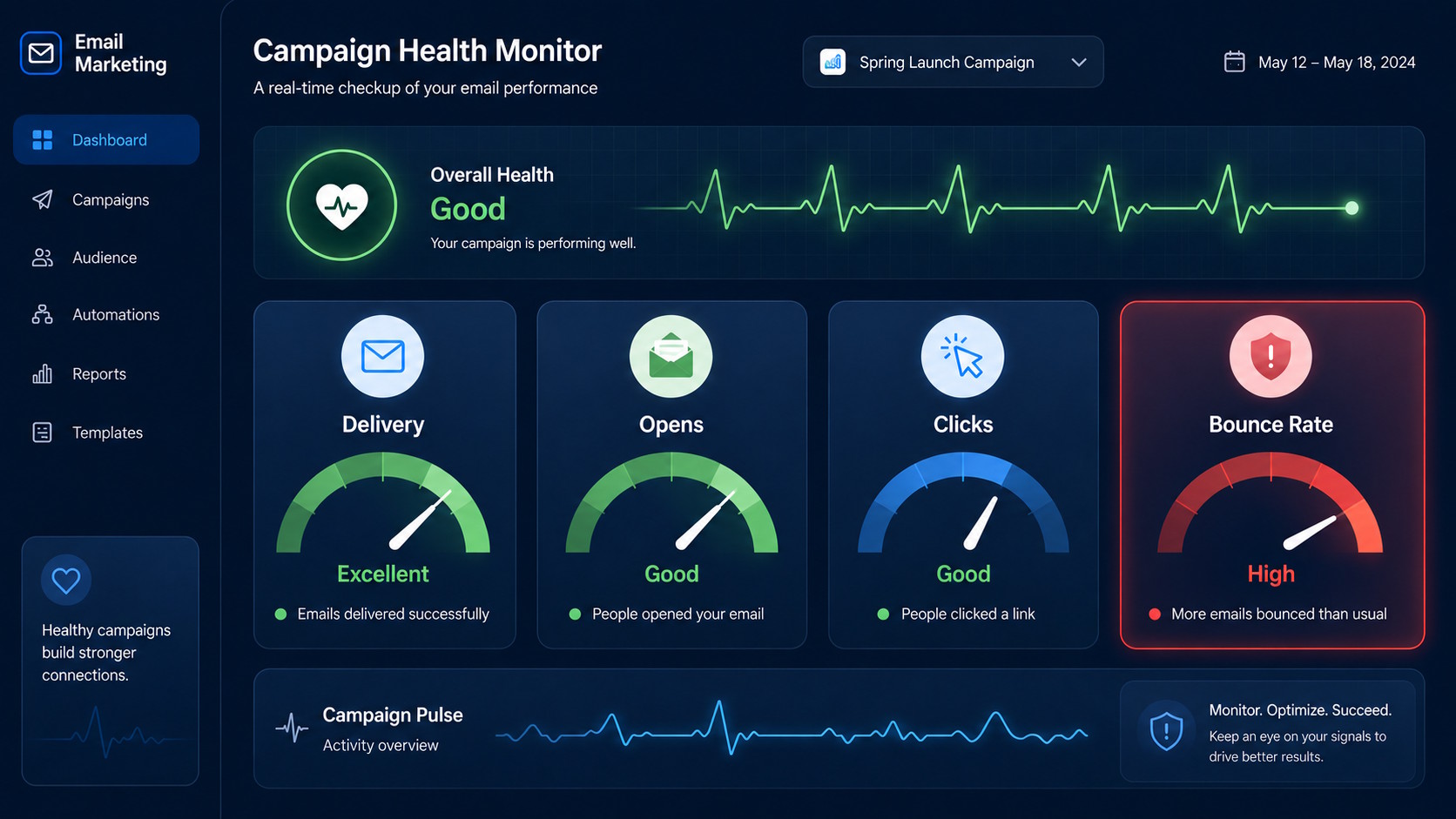
Quick Answer: Bounce rate in email marketing is the percentage of sent messages that could not be delivered. It can reveal problems with contact quality, data collection, or temporary delivery conditions. Hard bounces usually indicate permanent failures, while soft bounces often reflect temporary issues. The clearest insights come from the bounce type, timing, and concentration.
When “Sent” Does Not Mean Delivered
Email marketing depends on one simple event: your message must reach the recipient before anything else can happen. Yet some messages never arrive. In email campaigns, those failed deliveries appear as bounces. Your email outreach may look healthy at first glance, while the bounce rate points to hidden problems.
A bounce rate gives you a quick view of how many messages failed to reach their destinations. It can also reveal more than a delivery problem. The pattern may suggest outdated contacts, signup errors, or a temporary issue with a receiving server.
So, what does your bounce rate actually mean? The answer depends on the bounce type, when it happened, and where it appeared.
What Is Bounce Rate in Email Marketing?
Bounce rate measures the percentage of sent emails that could not reach their intended recipients. Most campaign platforms display this number after each send. A bounced message never reaches the point where someone can open, read, or click it. Bounce rate therefore measures delivery failure, not audience engagement.
Email marketing reports often place bounce rate beside opens and clicks. However, those metrics answer different questions. Two campaigns can share the same bounce rate and face completely different problems. One may contain invalid addresses. The other may encounter a temporary server delay.
One Term, Two Very Different Metrics
You may already know “bounce rate” from website analytics. Website bounce rate describes visitor behavior, while email bounce rate describes failed message delivery. The two metrics do not share the same causes or remedies. A website visitor may leave without taking another action. An email bounce happens before the recipient can engage at all.
Keeping that distinction clear prevents confusion. It also helps you ask the right questions when reviewing campaign results.
The Math Behind the Metric
The calculation is simple. Divide the number of bounced emails by the number sent, then multiply the result by 100. Suppose you send 1,000 messages and 20 bounce. Your bounce rate is 2 percent.
That percentage offers a starting point, but it does not explain the whole story. The type and pattern of the failures provide the real context. For an email marketing campaign, the headline number becomes useful only when you look beneath it.
Hard or Soft? The Two Main Types of Bounces
Email platforms usually divide bounces into two broad categories: hard bounces and soft bounces. Each category tells a different story.
Hard bounces point to permanent problems
A hard bounce usually signals a permanent delivery failure. The address may not exist, the domain may be invalid, or the account may have closed. Typing mistakes can also create hard bounces. A missing letter or incorrect domain can direct a message toward an address that never existed.
Another attempt will probably fail. However, a receiving server can sometimes reject a valid address permanently. The reported reason often provides better context than the label alone.
Soft bounces often reflect temporary trouble
A soft bounce usually signals a temporary delivery problem. The recipient’s inbox may be full, or the receiving server may be unavailable. A large message can also trigger a soft bounce. Some servers temporarily delay messages when traffic rises or automated filters become cautious.
One soft bounce does not always signal a serious issue. Repeated soft bounces from the same address deserve more attention. The pattern shows whether the trouble disappeared or continued.
What Can Your Email Marketing Bounce Rate Reveal?
The percentage itself offers only a headline. The real value appears when you examine the pattern behind it.
A sudden spike may point to a recent change
Did the rate jump after you imported new contacts? Did it rise after an event registration or signup campaign? A sudden increase often points toward something that changed recently. The source may contain typing errors, stale records, or poorly captured addresses. One unusual send may also reflect a temporary disruption. Comparing it with earlier campaigns helps separate an isolated event from a lasting weakness.
A slow climb may reflect aging contact data
Contact lists change even when nobody actively edits them. People leave companies, change roles, abandon accounts, and move to new providers. As a list ages, more addresses may stop working. A gradual rise can therefore reveal normal database decay. This does not mean the entire audience lacks value. It suggests that the data no longer represents that audience as accurately.
A cluster of bounces can narrow the search
An overall percentage can hide where the problem sits. A cluster often tells you more than the campaign average. Perhaps most failures came from one imported segment. Maybe one recipient domain rejected messages while other domains accepted them. The mix also changes the interpretation. Many hard bounces may suggest weak address quality. Many soft bounces may point toward temporary delivery trouble.
Why a “Good” Number Still Needs Context
You may wonder, “What is a good email bounce rate?” That natural question rarely has one universal answer. Audience type, list age, sending frequency, and collection methods can shape the result. Platforms may also classify some delivery failures differently.
A benchmark can offer perspective, but your own trend often provides stronger insight. Compare similar campaigns and watch for unusual movement. For email marketing teams, a steady trend is often more useful than a single benchmark. A sharp change deserves attention, even when the percentage still appears acceptable.
What Bounce Rate Cannot Tell You
Bounce rate answers one narrow question: Did the receiving system accept the message? It cannot explain everything that happened afterward. A delivered message may reach the main inbox, a promotions tab, or a spam folder. Bounce rate does not reveal that placement.
It also cannot show whether someone opened, read, clicked, replied, or purchased. Other campaign metrics track those actions. A low rate therefore does not guarantee strong performance. It simply shows that most receiving systems accepted the messages.
The overall percentage may also hide differences between groups. One healthy segment can offset a struggling segment in the campaign average.
Reading a Bounce Report Without Getting Lost
A campaign report becomes more useful when you move beyond the main percentage. A useful first step compares hard bounces with soft bounces. The platform’s error explanations can add valuable context. They may identify an invalid address, full mailbox, or temporary rejection.
A comparison with earlier sends can reveal whether the problem appeared suddenly. It can also show whether the issue grew over several months. You can then examine where the failures concentrate. Contact source, audience segment, recipient domain, and campaign type may expose a pattern.
The goal is not to overreact to every failed message. A bounce report works best as an early signal that guides a closer look.
Conclusion: Treat Bounce Rate as a Clue, Not a Verdict
Bounce rate can show whether part of your audience never received the chance to engage. It can also highlight changes in contact quality or delivery conditions. The number becomes more useful when you consider its type, timing, and concentration. Hard and soft bounces tell different stories. A sudden spike differs from a slow rise.
Viewed in context, bounce rate becomes a practical health signal rather than an isolated statistic. It helps you notice problems before they quietly distort your results.
Contact us if you want to learn more about email marketing metrics and what they reveal about your campaign health.