
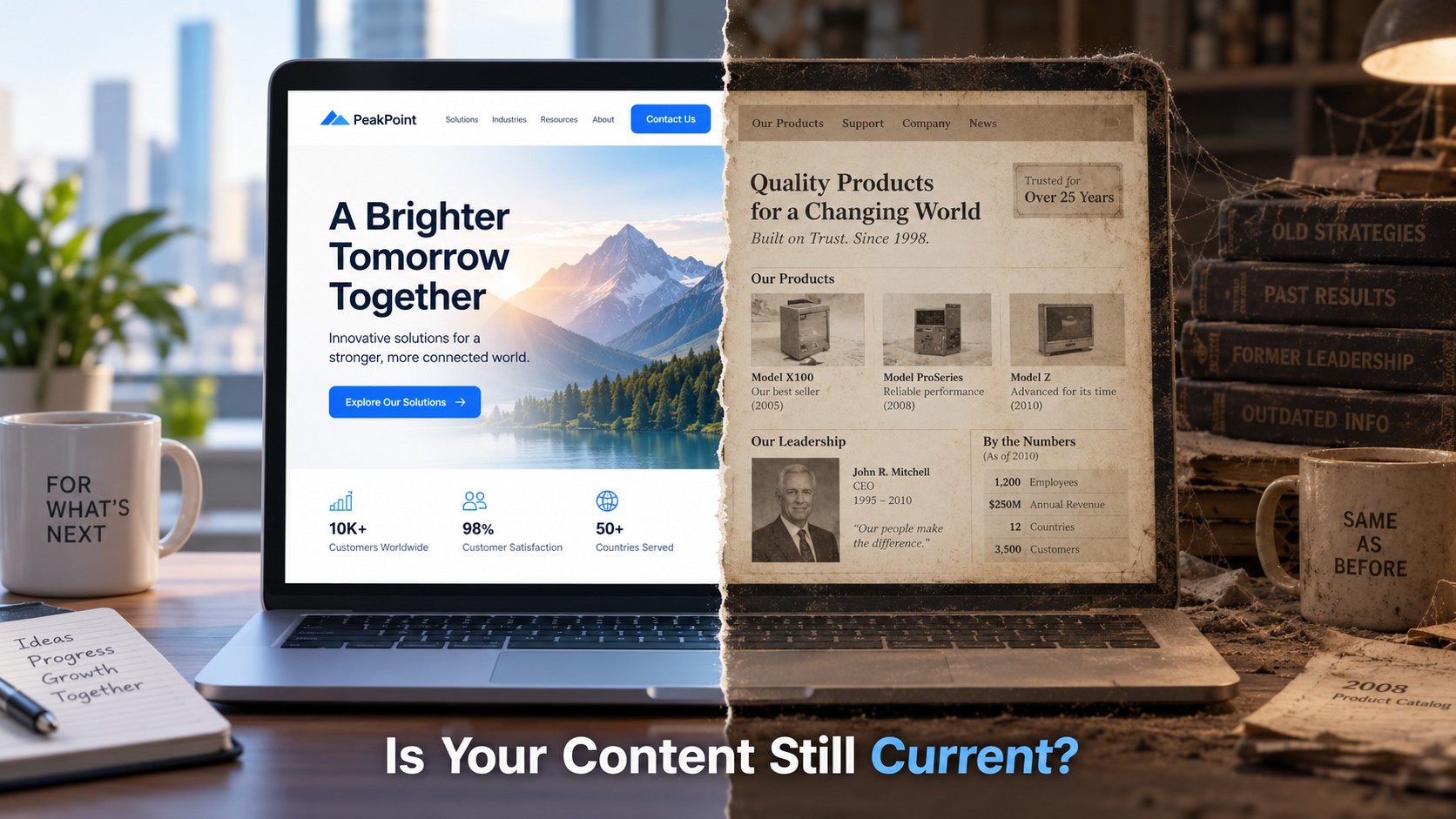
Key Takeaway: Content decay happens when older content loses relevance, accuracy, usefulness, or performance over time. In content marketing, outdated pages can do more than lose traffic. They can continue shaping how customers—and potentially AI systems—understand your brand, even after your products, services, or positioning have changed.
Has Your Content Kept Up With Your Business?
Content marketing can lose its value when older pages no longer reflect your business. Your content strategy may now focus on different products or audiences. Yet earlier brand storytelling can still present promises you have left behind.
Imagine a prospect discovering a buying guide that promises free installation with a product you stopped selling last year. They contact your team, ready to order, and the conversation begins with a correction rather than a welcome.
That scenario captures an overlooked part of content maintenance. The material you leave online can keep setting expectations, even when your latest campaign tells a different story.
What Is Content Decay in Content Marketing?
Content decay usually means a gradual decline in a page’s search traffic and rankings. Changing audience needs, stronger competing pages, and outdated information can contribute to that decline.
However, declining performance and declining accuracy are different problems. An accurate article can lose visitors, while an outdated product page can still attract them. This article focuses on that second concern: information that remains discoverable after it stops representing your business accurately.
A related issue is content debt. This is the accumulating cost of leaving outdated, inaccurate, or irrelevant material unattended. Content Marketing Institute describes it as a consequence of neglected maintenance, not simply a collection of old articles.
Why Good Content Stops Being a Good Fit
Content does not have to start badly to become a problem later.
Suppose your company introduces a new service package. You update the main sales page, but an earlier comparison article still describes the previous package. Both pages remain online, yet they give different answers to the same buying question.
Other changes can leave similar gaps. Executives move on, integrations change, and research becomes less suitable for describing present conditions. A company can also outgrow the positioning that once helped it stand apart.
Meanwhile, audience interests and competing content continue evolving. Your content marketing library needs attention even when nobody has made an obvious mistake.
When Yesterday’s Information Shapes Today’s First Impression
“What harm can an old blog post really do?”
Consider a fictional technology provider that once sold equipment but now also manages customers’ connected systems. An older article describes the company only as a hardware supplier. A reader seeking ongoing support might assume the provider cannot help.
Another hypothetical customer finds a comparison page promising an integration that the company no longer supports. Instead of discussing their needs, the sales team must first explain the mismatch.
Outdated leadership pages and conflicting service descriptions could create similar uncertainty. Even a statistic can mislead when an article presents a years-old survey as evidence of current customer preferences.
These examples illustrate possible consequences, not guaranteed lost sales. The concern is the expectation gap between what readers discover and what your business actually offers.
AI Gives Old Information Another Route to Your Audience
AI-generated answers add another reason to review older material.
Google explains that its AI search features can retrieve web pages and draw on them when generating responses. Readers can therefore encounter information through an answer rather than visiting each original page.
Imagine an assistant finding an outdated page about your discontinued product. It could describe that product as available if it fails to recognize the information is obsolete. The problem would involve repeating an old fact as current, rather than inventing a product.
However, AI systems do not all obtain information in the same way. OpenAI distinguishes responses based on training from those that use search to retrieve web information.
Updating your website does not directly rewrite a model’s training-based knowledge. Search updates also take time; Google says recrawling can take days to weeks. A correction is worthwhile, but it does not guarantee an immediate correction across every AI answer.
Does Every Old Page Need a Makeover?
No. Age alone does not make content inaccurate or useless.
A dated announcement naming the executive who led a company five years ago can remain a valid historical record. An undated leadership page naming that person as today’s executive creates a different impression.
Likewise, older research can provide historical context when the article clearly explains its timeframe. A useful explanation of a basic concept may need little revision.
The distinction is whether the content still serves its purpose without misleading readers. CMI’s interviewed practitioners similarly caution against using age alone to decide what to retire.
A helpful question is: “Would someone discovering this page today understand what is current and what is historical?”
How Can You Spot Trouble Before Customers Do?
A content audit is a review of what you have published and whether it still deserves its current form. It can cover accuracy and usefulness alongside performance. CMI recommends looking for outdated claims, duplicate material, and contradictions.
You could begin with pages that directly shape buying decisions. Product availability, pricing, company descriptions, and important capabilities offer a manageable starting point.
Within your content marketing library, broken links and obsolete references deserve attention too. Falling search traffic can prompt a review, although it does not prove that information is wrong.
An old publication date is a reason to look closer, not a verdict. You could also ask sales colleagues which misunderstandings they regularly need to correct.
Refresh, Explain, Combine, or Retire?
The right response depends on what the page still contributes. Useful material with incorrect details may need an update rather than a complete rewrite.
Historical content may need clearer context, such as a visible date and a note explaining what has changed. Overlapping pages may work better together, especially when maintaining separate versions creates conflicting guidance.
Retirement becomes an option when content no longer serves a useful purpose. A relevant replacement may justify a redirect, but not every old page needs removal. These choices reflect CMI’s emphasis on evaluating content before refreshing, consolidating, or retiring it.
Merely changing a publication date does not correct inaccurate information. Google specifically warns against making pages appear fresh without substantially changing their content.
Content Marketing Has a Life After Publication
A publishing calendar shows what comes next. A maintenance plan asks whether what already exists still deserves readers’ trust.
For your team, that could mean assigning someone responsibility for important pages after launch. A product change could then trigger a review of related guides, comparisons, and downloadable resources.
CMI’s discussion of content debt highlights the problem of responsibility ending when content goes live.
This does not require treating every article as an emergency. It means allowing content maintenance a place beside content creation, rather than waiting for a customer to uncover a contradiction.
Conclusion: Let Your Content Catch Up With Your Business
The prospect from the introduction should not need a sales conversation to discover that an advertised offer no longer exists. Accurate content can help that conversation begin with their needs instead of a correction.
Addressing content decay involves more than chasing traffic. It also means examining whether the information people still find gives them a fair picture of your business.
Contact us at IoT Marketing to learn more about managing content decay in your content marketing.
Sources:
How To Handle the Old Content AI Keeps Finding | contentmarketinginstitute.com
What Is Content Decay? (And How to Fix It Before It Tanks Your Traffic) | ahrefs.com
How To Reduce Content Debt and Get Buy-In | contentmarketinginstitute.com
Creating Helpful, Reliable, People-First Content | developers.google.com
0 comments