
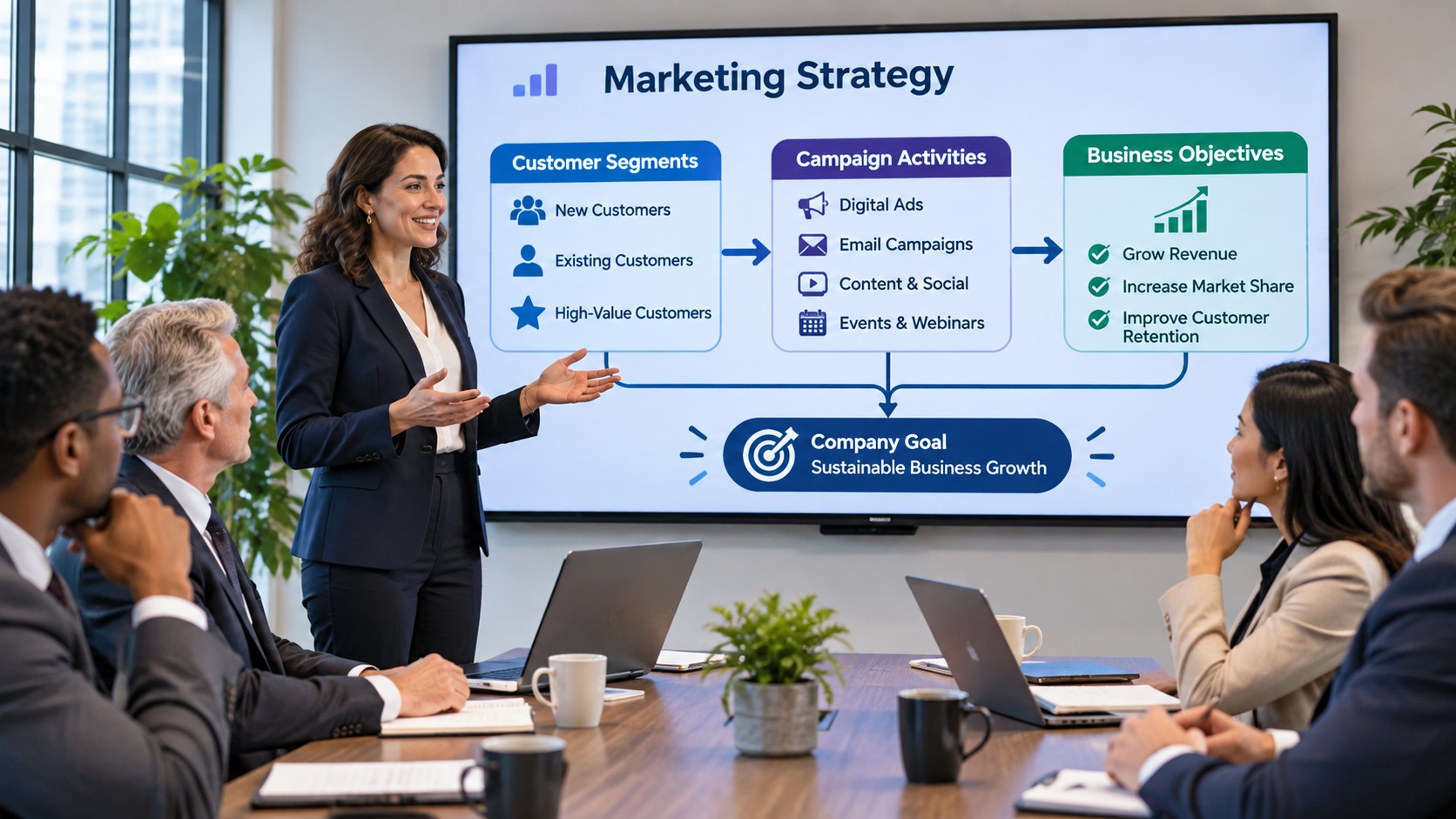
Key Takeaway: Explaining marketing strategy to stakeholders starts with connecting marketing decisions to clear business goals. Focus on the customers you want to reach, explain the reasoning behind your approach, and show how proposed activities support company objectives. Use practical examples, relevant performance measures, and open discussions to help stakeholders understand the strategy, evaluate its potential, and contribute to better decisions.
When the Plan Meets the Meeting Room
Marketing strategy guides how your business attracts customers, yet explaining it to stakeholders can become an unexpected challenge. Your marketing plan might make perfect sense to the team, while colleagues struggle to see the business case.
You might hear, “Why are we targeting those customers?” or “How will this campaign help sales?” A budget discussion can suddenly become a debate about posting more on social media. Meanwhile, everyone still needs to understand what the company hopes to achieve.
Your stakeholders include anyone who approves, supports, or helps deliver the plan. A useful explanation connects your business goal with customer needs, the choices you’ve made, and the evidence behind them. It also gives colleagues room to question assumptions and contribute what they know.
Give Your Marketing Strategy a Business Purpose
A marketing strategy sets out which customers you prioritize, what value you offer, and how you intend to win business. Those choices should connect to an objective that people across the company understand.
Perhaps you want to attract customers in a new market or encourage existing customers to buy again. Naming that objective gives the discussion a starting point before anyone asks about advertising budgets or email schedules.
The 2026 CMO Survey asked marketing leaders how they show their function’s value to other departments. Among 248 respondents to that question, 75 percent reported demonstrating marketing’s financial impact.
The business goal should explain why an activity deserves time and money. For a webinar, that means showing which customer opportunity makes the event worth organizing.
For example, “We want to reach more buyers who need inventory software” gives colleagues a clearer direction than “We need more content.” Your explanation can then show how the proposed content serves those buyers and supports the business goal.
A Different Seat Brings Different Questions
A finance colleague might worry about spending before revenue arrives. Your sales manager may want fewer unsuitable inquiries, while an operations leader considers the team’s capacity.
Each concern can be reasonable, even when the people raising it understand marketing. Before a presentation, a short conversation can reveal which decisions they need to make.
You might ask, “What would help you evaluate this approach?” Their answer gives you a starting point for an explanation that respects their responsibilities.
Your marketing strategy should remain consistent across those conversations. Finance may need the spending assumptions, while sales needs to understand which customers the campaign should attract. Both should hear the same business goal.
One Example Can Make the Choices Click
Consider a hypothetical software company that wants to attract more small manufacturers. Customer interviews suggest that some struggle with inventory errors and spend hours checking stock manually.
The company believes its software could help those businesses track inventory more accurately. Its marketers therefore propose concentrating on manufacturers with that problem.
A stakeholder might ask, “Why focus there when other companies could also buy our product?” A useful explanation would connect the customer feedback with the product’s strengths and the team’s available resources.
Marketing strategy at the factory door
The team could propose an educational webinar about reducing inventory mistakes. Prospective buyers can explore a relevant problem before deciding whether a product demonstration would help.
The marketer can then explain how the webinar supports the broader customer focus. Registrations from relevant manufacturers would suggest interest; later conversations could reveal whether those businesses need the software.
There is a trade-off, too. Spending on this audience leaves less money for campaigns aimed at retailers or other potential customers.
Walking through that choice gives stakeholders something specific to evaluate. They can examine the evidence, question the focus, and suggest information the team may have missed.
Progress Needs a Shared Meaning
“When will we know whether this is working?” deserves a clear answer, although every activity has its own timeline.
For the software company, webinar attendance would show participation. Relevant inquiries and requests for demonstrations could indicate stronger interest, while sales would provide a later business result. These measures tell different parts of the story. A busy webinar alone would not establish that the campaign generated profitable customers.
You can agree beforehand on which measures to review and when. A useful discussion also covers what would prompt the team to adjust its approach. Stakeholder feedback belongs in that review. A sales colleague might recognize that attendees describe a different problem from the one the campaign addresses.
A Chartered Institute of Marketing webinar on internal support emphasized business goals, supporting evidence, and open dialogue. That approach leaves room for colleagues to improve the proposal as they learn more about it. A question such as, “Does this match what you hear from customers?” invites practical knowledge into the discussion. The answer may strengthen your marketing strategy or reveal an assumption that needs another look.
Conclusion: Leave with More Than a Nod
Stakeholders should leave with a clear picture of the customers you want to reach and the opportunity you see. They should also understand why the proposed activities deserve resources and what evidence could change the plan.
Your next meeting can begin with one business goal and one example that makes the choices tangible. From there, the discussion can move toward what everyone needs to learn before committing more time or money.
A thoughtful question at the end may be more useful than a room full of polite nods.
Contact us to learn more about explaining your marketing strategy and helping stakeholders make informed decisions.
Sources: